There is a moment that happens every April and May in south-west Sydney — the mornings get that little bit crisper, the afternoon light softens earlier, and the temptation to keep everyone inside grows steadily. The jackets come out. The heater goes on. And outdoor play, almost imperceptibly, starts getting shorter.
At Saige Early Learning, this is the moment we lean into outdoor learning harder, not softer. Because the cooler months are not a reason to move physical activity indoors — they are actually one of the best times of the year for it.
Why Physical Development Cannot Wait for Warmer Weather
Young children need to move. Not occasionally, not when conditions are perfect, but every single day — and in generous, uninterrupted blocks of time that allow for the kind of full-bodied, exploratory, physically demanding play that builds the foundations of everything else.
The Australian 24-Hour Movement Guidelines for the Early Years recommend that children aged three to five accumulate at least three hours of physical activity spread throughout the day. That target does not come with a seasonal asterisk. It applies in April just as it does in January — and meeting it in the cooler months requires a little more intentionality, but absolutely no less commitment.
The developmental stakes are real. Gross motor development — the coordination, strength, balance, and body awareness that comes from running, jumping, climbing, rolling, and carrying — is not simply about physical fitness. It is the foundation upon which fine motor skills, literacy, numeracy, and cognitive function are built. A child who spends the majority of their day seated, still, and indoors is not just missing physical development. They are missing the sensory input, spatial learning, and neurological stimulation that the body in motion provides to the developing brain.
Movement is not a break from learning. For young children, movement is how learning happens.
What Cooler Weather Actually Offers
Here is something worth reframing: the cooler months of autumn and early winter in the Gregory Hills area are not an obstacle to outdoor physical activity. In many ways, they are the ideal conditions for it.
Mild temperatures mean children can run, climb, and engage in sustained active play without the heat exhaustion that cuts outdoor sessions short in the height of a Western Sydney summer. The sensory environment shifts — the smell of cooler air, the feel of dew on grass, the crunch of leaves underfoot — offering a richness of sensory experience that warm, dry months simply do not provide. Children who play outdoors in varied weather conditions develop a broader, more resilient physical relationship with the natural world, and a greater confidence in their own bodies across different environments.
Cool mornings spent digging in damp soil, running through fallen leaves, carrying and stacking outdoor materials, navigating uneven terrain — these are not just charming scenes. They are sophisticated physical and cognitive workouts that develop core strength, proprioception, fine and gross motor coordination, risk assessment, and spatial reasoning all at once.
Gross Motor Development: Building the Foundation
In the cooler months at Saige Early Learning, our outdoor program deliberately prioritises the gross motor experiences that underpin physical literacy — the ability to move through the world with confidence, coordination, and competence.
Climbing develops upper body strength, spatial awareness, and the kind of whole-body coordination that will later support writing, drawing, and seated concentration. Running — especially running that changes pace and direction, navigating obstacles and other children — builds cardiovascular health, balance, and the neurological pathways that support executive function. Jumping, landing, and rolling develop proprioceptive awareness — the body’s understanding of where it is in space — which is foundational to everything from sports to handwriting.
Ball play, balancing on uneven surfaces, carrying objects of different weights, and navigating the physical challenges of a well-designed outdoor environment all contribute to a physical foundation that school-aged learning genuinely depends upon.
A child who arrives at kindergarten with well-developed gross motor skills sits more comfortably, holds a pencil more capably, manages the physical demands of the school day with greater ease, and brings more of their cognitive resources to learning rather than to the effort of managing their body.
Fine Motor Development: The Smaller Movements That Matter
The link between gross motor and fine motor development is more direct than many families realise. Core strength and shoulder stability — built through climbing, crawling, carrying, and whole-body play — are the physical prerequisites for the hand control and pencil grip that formal schooling eventually requires.
In the cooler months, we also deliberately weave fine motor rich experiences into the outdoor environment. Gathering and sorting natural materials. Pouring and measuring in the mud kitchen. Threading autumn leaves onto string. Building with sticks and clay. Manipulating play dough in the outdoor space. These activities feel like play — because they are — but they are simultaneously building the hand strength, pincer grip, and bilateral coordination that underpin writing, drawing, cutting, and fastening.
Dressing for the Outdoors: A Developmental Practice in Itself
A small but genuinely important note: getting dressed for cooler weather is itself a rich opportunity for fine motor development and independence. Managing zips, buttons, toggles, and velcro fasteners — putting on a jacket independently, pulling up a hood, managing gloves — all develop the hand strength and dexterity that formal learning later demands.
We encourage families to dress little ones in layers that they can manage themselves where possible, and to allow the extra two or three minutes it takes for a child to practise these skills independently rather than doing it for them. The jacket that takes five minutes to do up at four years old is the same jacket that builds the hand control that makes writing easier at five.
Active Learning Indoors: When the Weather Does Keep You In
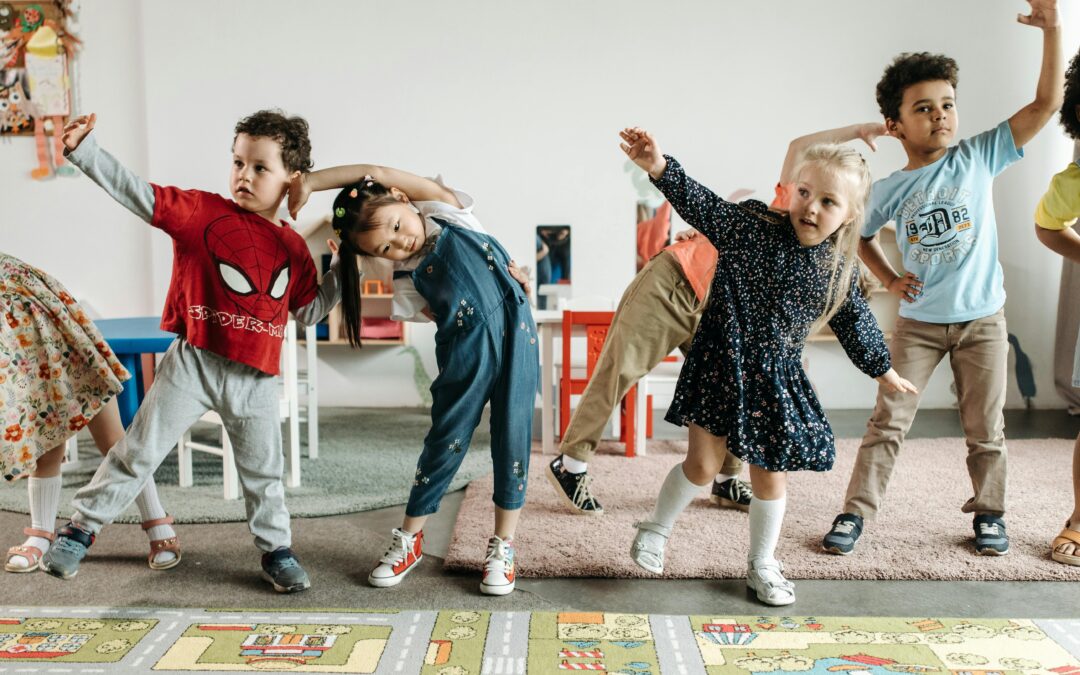
On the genuinely cold or wet days that do occasionally arrive in south-west Sydney, we bring physical learning inside — thoughtfully and intentionally. Obstacle courses using cushions, tunnels, and balance boards. Movement-based music and dance. Yoga and stretching that builds body awareness and breath control. Construction and building that requires lifting, carrying, and whole-body engagement. Sensory play that gives hands and bodies the input they need even when the outdoor space is temporarily off the table.
The goal is always the same: a child whose body has moved enough, whose nervous system has been appropriately stimulated, and who arrives at quieter learning experiences genuinely ready to engage rather than restless and frustrated from too much stillness.
What Families Can Do at Home
The physical development that happens at our centre is most powerful when it is matched by active time at home too. A few simple practices that make a real difference in the cooler months:
Commit to a daily outdoor moment regardless of the temperature — even twenty minutes at a local park, a walk around the block, or time in the backyard before dinner. Gregory Hills has beautiful open spaces and walking paths that are genuinely enjoyable in cooler weather once you are rugged up and moving.
Resist the pull of screens as the primary indoor activity on cold afternoons. Obstacle courses in the hallway, dancing in the kitchen, building forts that require carrying and construction, and active imaginative play all serve the physical and neurological development that screens cannot.
Let your little one be physical in ways that feel slightly uncomfortable to watch — climbing higher than feels quite comfortable, running faster than feels quite safe, jumping from things that make you wince slightly. Appropriate physical risk is how children develop body confidence, risk assessment skills, and genuine physical capability. Our job as the adults around them is not to eliminate challenge but to ensure the environment is reasonably safe and then step back and let them test their limits.
The cooler months are not a pause in your child’s physical development. At Saige Early Learning, they are an active, deliberate, joyful season of it — and we would not have it any other way.
Sources
- Australian Government Department of Health – Australian 24-Hour Movement Guidelines for the Early Years (Birth to 5 Years) https://www.health.gov.au/resources/publications/australian-24-hour-movement-guidelines-for-the-early-years-birth-to-5-years
- Australian Children’s Education & Care Quality Authority (ACECQA) – Belonging, Being & Becoming: The Early Years Learning Framework for Australia (EYLF V2.0) https://www.acecqa.gov.au/sites/default/files/2023-01/EYLF-2022-V2.0.pdf
- Hanscom, A. – Balanced and Barefoot: How Unrestricted Outdoor Play Makes for Strong, Confident and Capable Children (New Harbinger Publications, 2016) https://www.newharbinger.com
- Raising Children Network – Physical Activity for Children: Why It Matters https://raisingchildren.net.au/toddlers/play-learning/outdoor-play/physical-activity
- Fjørtoft, I. – The Natural Environment as a Playground for Children: The Impact of Outdoor Play Activities in Pre-Primary School Children, Early Childhood Education Journal (2001) https://link.springer.com/journal/10643
- Piek, J. et al. – The Role of Early Fine and Gross Motor Development on Later Motor and Cognitive Ability, Human Movement Science (2008) https://www.journals.elsevier.com/human-movement-science
- Zero to Three – The Importance of Movement and Physical Play in the Early Years https://www.zerotothree.org
- Saige Early Learning – Our Approach to Outdoor Learning and Physical Development https://www.saigeearlylearning.com.au