Saige Early Learning acknowledges the Dharawal people as the Traditional Custodians of the lands and waters of Gregory Hills and the Camden region. We pay our deep respect to Elders past, present, and emerging, and honour their enduring connection to Country, culture, and community — and to the ancient tradition of storytelling that has kept knowledge, relationship, and belonging alive on this Country for thousands of generations.
Pablo Picasso — whose words sit close to our heart at Saige — once observed that every child is an artist. We might add: every child is also a storyteller.
Before a child can read a word, they are already living inside stories. They are the protagonist of the story they are telling themselves about who they are and what the world is like. They narrate their play in vivid, running commentary. They retell yesterday’s adventure with the kind of dramatic flourish that would make a novelist envious. They listen to a picture book being read aloud with their whole body — eyes wide, leaning in, gasping at the right moment, devastated or delighted when the story ends.
Children do not need to be taught to love stories. They arrive in the world already in love with them. What we can do — at Saige Early Learning in Gregory Hills, and in partnership with the families who trust us with their children’s early years — is give that love the richest possible soil to grow in.
In May, as autumn settles over south-west Sydney with its cooler mornings, its softer light, and its invitation to draw closer and be still, the conditions for storytelling are perfect. The season itself is a story — of change, of colour, of things transforming into other things and the world becoming, for a few months, something slower and more golden than it was before.
At Saige, we call this our Seasonal Storytelling season. And we want to take you inside it.
Why Storytelling Is the Foundation of Everything
The NSW Department of Education defines literacy in early childhood in a way that may surprise families who think of literacy primarily as reading and writing. In the early years, literacy “incorporates a range of modes of communication, including music, movement, dance, storytelling, visual arts, media and drama, as well as talking, listening, viewing, reading and writing.”
Storytelling is not a warm-up to literacy. It is literacy — in one of its most powerful and developmentally fundamental forms.
The research is unambiguous. The State Library of NSW, in partnership with the Institute of Early Childhood at Macquarie University, developed an evidence-based early literacy framework for NSW that identifies oral language and storytelling as foundational to children’s entire literacy development pathway. Children who hear stories regularly — who are read to, who hear tales told without a book, and who are given space and encouragement to tell their own — develop larger vocabularies, more sophisticated sentence structures, richer listening comprehension, and a more confident, fluent relationship with language in all its forms.
This matters because language is not simply a communication tool. It is, as the NSW DoE observes, “the medium through which memories are retrieved, facts are recalled and thought takes place.” A child with a rich, confident language base is a child who can think more richly and confidently — about everything, for the rest of their life.
And it all begins with a story.
The Three Modes of Seasonal Storytelling at Saige
Our Seasonal Storytelling program in May works across three distinct but interconnected modes, each of which serves the same ultimate purpose: building the language, imagination, and narrative understanding that will carry our children into school and beyond.
Mode One: Being Read To — The Gift of a Quality Text
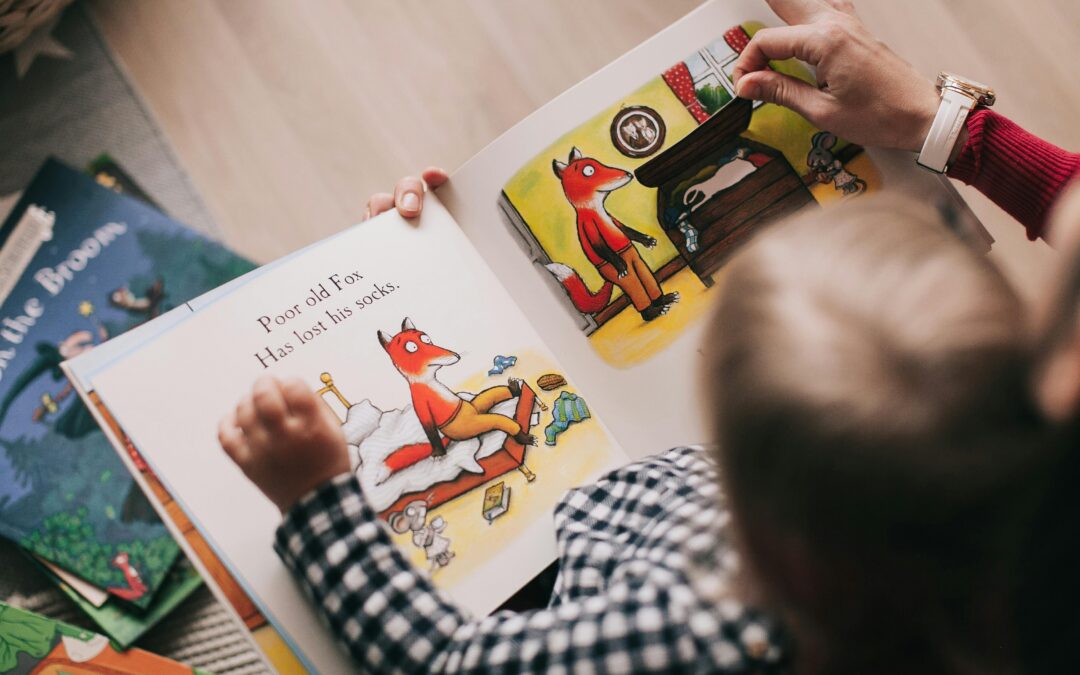
There is something irreplaceable about the experience of being read to well.
Not simply the information or the plot — but the experience itself: the warmth of sitting close to an educator or parent who cares about you, the particular quality of attention that a good picture book creates, the way a well-chosen word or a perfectly placed illustration can stop time for a moment and make both the reader and the listener feel that something true has just been said.
The NSW Department of Education is explicit: “Reading to and with children at preschool supports a lifelong love of reading.” Quality texts are specifically identified as important to engage children in early reading skills. And the State Library of NSW’s early literacy research, conducted with Macquarie University, identifies shared book reading between adults and children as producing positive gains in vocabulary, comprehension, and oral language complexity.
At Saige, our approach to read-aloud is intentional and unhurried. We choose our autumn texts with care — books whose language is rich, whose illustrations reward close attention, whose themes connect to the actual world our children are inhabiting in May. We read slowly. We pause. We wonder aloud: What do you think will happen? How do you think the character feels? What would you do?
These questions are not comprehension tests. They are invitations — to imagine, to empathise, to step inside a story and make it your own.
Our May reading list celebrates the themes of autumn: change and transformation, the relationship between living things and the seasons, the warmth of being cosy and close, the wonder of a world that looks different this month than last month. We reach for Australian authors and illustrators — for the voices and landscapes that reflect where our children actually are — as well as beloved international classics that have earned their place in early childhood canons through the sheer power of their storytelling.
Some titles we return to every autumn at Saige include the enduring works of Mem Fox — whose picture books have brought Australian families together across generations through language of extraordinary warmth and precision — alongside the vivid nature writing of Jackie French, whose work connects children to the Australian landscape with genuine ecological attentiveness. We complement these with international autumn classics: David Ezra Stein’s tender story of a young bear encountering falling leaves for the first time for our younger rooms; Julia Rawlinson’s Fletcher and the Falling Leaves for our kindy children, who bring their own questions about why trees change and what happens to things that fall.
We also leave space for the books that our families bring us — the stories from different cultures, different languages, different storytelling traditions. Because the NSW Department of Education reminds us: “Share stories from your culture, your family stories and your child’s stories.” Every family has autumn. Every family has stories. They are all welcome here.
Mode Two: Oral Storytelling — Tales Without a Book
In early childhood literacy circles, there is growing recognition of something that storytelling cultures around the world have always known: the told story — the story that comes from a person rather than a page — does something different to a listener than the read story.
When an educator or parent tells a story without a book, several things happen simultaneously. The child must build the entire world of the story in their own imagination, from words alone. They develop the capacity to sustain mental imagery across time — to hold characters, settings, and events in working memory as the narrative unfolds. They develop the inferential comprehension skills — the ability to understand what is implied rather than stated — that are among the most important predictors of later reading success.
The NSW DoE’s fostering literacy in early childhood research notes that oral language is the prerequisite to literacy: that children’s spoken language competence is the foundation on which their reading and writing competence will be built. Oral storytelling, practiced regularly, is one of the most powerful ways to develop that spoken language foundation.
At Saige in May, our educators tell stories. Not from memory of published texts, but original stories — created in the moment, responsive to the children in the room, woven from the materials of autumn that surround us:
- A story about a leaf who was afraid to fall
- A tale of the morning mist that lives in the valley below Gregory Hills and comes out to play on cool May mornings
- A story about the shadow that grew longer and longer as autumn came and the sun moved lower in the sky
- A tale of the first people of the Dharawal Country who knew the secrets of every tree, every stone, every season of this land
These stories do not need to be literary masterpieces. They need to be told with warmth, with commitment, and with genuine attention to the children who are listening. A story told to a four-year-old who is watching your face — who gasps when you gasp, who leans in when the voice drops low, who already knows something wonderful is coming — is one of the most fundamentally human experiences early childhood can offer.
Mode Three: Children’s Own Stories — The 100 Ways to Tell
At Saige, our 100 Ways to Play program is built on the understanding that play is how children learn, and that learning is most powerful when children are the authors — not simply the audience.
Storytelling, in this spirit, is not only something that happens to children. It is something they do. And in May, the season gives them extraordinary material.
A child who has collected autumn leaves and arranged them into a sequence on the ground is making a story — beginning, middle, end, the arc of change. A child who takes two stick puppets into the mud kitchen and creates a narrative while they play is developing narrative structure, character voice, dialogue, and emotional intelligence simultaneously. A child who draws a picture of the grey winter sky and dictates to an educator what is happening in it is exercising every element of early literacy except the physical act of mark-making on the page — and that will come.
The NSW Department of Education’s early childhood literacy resources describe this beautifully: children’s literacy includes how they “read the meaning of their paintings, scribbles, and drawings to other children, families, or educators.” The scribble that a three-year-old explains to you with great seriousness is not pre-literacy. It is literacy — their literacy, at this stage of their development, as fully real and as fully worthy of your respectful attention as any printed word.
In our May program, we create provocations that invite children’s own storytelling:
The Story Stone Collection — smooth river stones, each painted with a single image drawn from the natural world of Dharawal Country in autumn: a leaf, a crow, a raindrop, a shadow, a moon, a gumnuts cluster. Children select three stones and make a story. Every combination creates a different narrative. Every narrative is right.
The Loose Parts Story Map — natural materials spread across a floor mat: sticks, bark pieces, seed pods, stones, moss, a piece of soft fabric for “the river.” Children use these to build the world of their story and narrate as they create. Educators observe, listen, ask the occasional wondering question, and document.
The Big Book of Our Stories — a large, plain-page book that lives in our book corner throughout May. Children contribute: a drawing, a dictated sentence, a page they have made at home with a family member. By the end of the month, it is a real book — authored by the children of Saige, illustrated with the materials of our autumn, written in the language of our community.
The Language of Autumn: Why This Season Is Especially Rich for Storytelling
Every season has its own vocabulary, its own sensory palette, its own emotional register. Autumn’s, for young children, is particularly abundant.
The words of autumn are golden words — rich with texture, colour, and sensation. Crisp. Rustle. Drift. Huddle. Bare. Ember. Mist. Harvest. Shelter. Cosy. These are not simple, monosyllabic words. They are words that carry images and feelings inside them, that do more than denote — they evoke. And for young children building their vocabulary, a word that evokes something is a word they will remember.
The NSW DoE’s fostering literacy guidance notes that oral language, vocabulary, and early literacy are deeply interconnected in the early years: “Educators know that oral language and vocabulary are important aspects of literacy when learning to read, write and communicate.” Building children’s vocabulary through exposure to rich, seasonally grounded language — through stories, through conversation, through the naming and describing of the actual world — is one of the highest-value literacy practices in early childhood.
At Saige, our autumn storytelling program is intentionally a vocabulary-building program as well. We introduce autumn words through stories, through song, through the 100 Ways to Play. We use them ourselves, repeatedly and with pleasure, because children learn vocabulary by hearing it in context — not from a word list, but embedded in the language of people who enjoy language.
Storytelling at Home: Autumn Reading and Telling for Gregory Hills Families
The most powerful thing about storytelling as a literacy practice is that it requires no special materials and no particular expertise. It requires only time, attention, and the willingness to be present with a child who is ready to listen and ready to tell.
Here are some autumn storytelling practices for Saige families at home in Gregory Hills:
- The Bedtime Story — Every Night, If Possible The NSW Department of Education’s resources for families and the State Library of NSW’s early literacy research converge on the same finding: regular shared reading between adults and children is the single most impactful thing a family can do for their child’s language and literacy development. Not every night has to feature an elaborate book — some nights it is one page of a favourite, read in a tired, half-lit bedroom. But the habit of story, the nightly ritual of language before sleep, is building something profound.
- Tell a Story Without a Book On the drive home from Saige, or on a walk through the neighbourhood, try telling a story rather than reading one. Begin with: “Once there was a leaf who lived on a very tall tree in Gregory Hills…” and see where it goes. Ask your child: “What do you think happens next?” Let them take over. Let the story become theirs.
- Visit the Local Library The Camden Council library service — our local resource as a Gregory Hills community — offers regular storytimes for young children, picture book collections that are refreshed seasonally, and family literacy programs. NSW public libraries are a central part of the State Library of NSW’s early literacy strategy: free, welcoming, and specifically designed to support children’s language and literacy development in partnership with families.
- Ask for Their Story At the end of a day, instead of asking “What did you do today?” (a question that often produces a shrug), try: “Tell me the story of your day. Who was the main character? What was the most exciting bit? Was there a problem? How did it get solved?” This frames experience as narrative — which is exactly how human memory works — and gives children practice in the story structures they will later use when they read and write.
- Make a Family Autumn Book Together Collect autumn leaves, seed pods, and small natural objects over a weekend walk. Come home and create a very simple book together: one natural object per page, glued or pressed, with your child’s words beneath it. “This is a leaf. It was red. It fell from the tree.” Three words or thirty — it does not matter. What matters is that your child’s words have been treated as worth recording. That their observations have been made permanent and shared. That they are, in the fullest sense, an author.
Storytelling, the EYLF, and Saige’s Vision
Our Seasonal Storytelling program is grounded across all five outcomes of the Early Years Learning Framework V2.0:
Outcome 5 — Effective Communicators: This is where storytelling is most explicitly situated. The EYLF describes children as “listen[ing] to and engag[ing] with oral and visual texts” and “activley use, engag[ing] with and shar[ing] the enjoyment of language and texts.” Storytelling — in all three of its modes at Saige — is the direct expression of this outcome, experienced through the whole body, with genuine emotional investment, every day.
Outcome 4 — Confident and Involved Learners: A child who can tell their own story is a child who knows their experience is worth recording, their perspective worth sharing, their imagination worth taking seriously. That is confidence. And it is exactly the confidence — in their own ability to make meaning, to participate, to contribute — that will carry them into Kindergarten and beyond.
Outcome 1 — Strong Sense of Identity: Identity is narrative. We know who we are through the stories we tell about ourselves and the stories we hear told about our community. When a child at Saige hears stories from their own cultural heritage reflected in our program, when they see their family’s autumn traditions woven into our seasonal storytelling, they receive a message that their identity belongs here — fully and without qualification.
Outcome 2 — Connected to Their World: Stories about the natural world of Dharawal Country, about the ecology of autumn in south-west Sydney, about the seasonal rhythms of the Cumberland Plain — these connect children to the specific, living world they inhabit. That connection is both ecological and spiritual, and it begins with a story.
Outcome 3 — Strong Sense of Wellbeing: There is a reason storytelling has been a universal human practice for as long as there have been humans. It is regulating. It is connecting. It is, in the most direct sense, a wellbeing practice — and the child who is read to every day, who lives inside stories, who knows that language is a place of warmth and safety, is a child whose emotional and social wellbeing is quietly, consistently nourished.
Come and Tell Stories With Us
At Saige Early Learning, we believe — with Picasso, with Einstein, with Fred Rogers, and with every child who has ever leaned in close to hear what happens next — that imagination is the most important thing we can nurture in these early years.
Stories are how imagination lives in the world. And autumn is when they are most at home.
We would love to share a story with you.
📍 67-77 Lasso Road, Gregory Hills NSW 2557 📞 (02) 4602 5515 ✉️ enrolments@saigeearlylearning.com.au 🌐 saigeearlylearning.com.au 🕐 Open Monday – Friday, 6:30am – 6:30pm
Sources
The following NSW-based and nationally recognised sources were used in the research and writing of this blog post. No other early childhood or childcare services have been cited as sources.
- NSW Department of Education — Literacy in Early Childhood education.nsw.gov.au — Literacy in Early Childhood — NSW Department of Education professional learning resource defining early childhood literacy as encompassing storytelling, oral language, music, movement, drama, and visual arts, and confirming that reading to and with children at preschool supports a lifelong love of reading.
- NSW Department of Education — Fostering Literacy and Numeracy in Early Childhood education.nsw.gov.au — Fostering Literacy and Numeracy — NSW Department of Education guidance on oral language and vocabulary as central pillars of early literacy, and the role of storytelling, narrative play, and shared reading in developing children’s capacity to read, write, and communicate throughout their schooling.
- NSW Department of Education — Resources for Families education.nsw.gov.au — Resources for Families — NSW Department of Education family learning resources including learning outcome cards and the five-part Learning Every Day in Every Way Through Play podcast, providing families with evidence-based guidance on supporting children’s language and literacy development through everyday storytelling and reading at home.
- State Library of NSW — Early Language and Literacy in NSW Public Libraries pls.sl.nsw.gov.au — Early Language and Literacy — The State Library of NSW’s evidence-based early literacy framework, developed in partnership with the Institute of Early Childhood at Macquarie University, establishing the research foundation for storytelling, shared reading, and oral language development as foundational to children’s literacy outcomes in NSW.
- State Library of NSW — Early Language and Literacy in NSW Public Libraries: Framework for Developing and Evaluating Early Literacy Sessions pls.sl.nsw.gov.au — Early Literacy Framework for Libraries — The State Library of NSW’s toolkit for early literacy programs in public libraries, including the Camden Council library service, providing principles and strategies for supporting children’s language and literacy through storytimes, family reading programs, and community engagement.
- NSW Department of Education — Promoting Literacy and Numeracy in Preschool education.nsw.gov.au — Promoting Literacy in Preschool — NSW Department of Education professional learning for early childhood educators, examining evidence-based approaches that promote and extend early literacy and language development through storytelling, play-based learning, and intentional teaching in preschool settings.
- Early Childhood Australia — NSW Branch earlychildhoodaustralia.org.au — NSW Branch — NSW’s peak advocacy body for early childhood education and care, providing research and resources on children’s literacy and language development, storytelling and literature in early childhood, the EYLF V2.0 Outcome 5 (effective communicators), and best practice in oral language and reading programs.
- NSW Government — Families and Parenting nsw.gov.au — Family and Relationships: Parenting — NSW Government guidance for families on supporting children’s language development, reading habits, and early literacy at home, including the role of daily reading, oral storytelling, and family narrative practices in building the language and literacy foundations children need before starting school.
Saige Early Learning is a child-centred early learning centre in Gregory Hills, NSW, nurturing the natural curiosity and creativity of every child from 0 to 5 years. Our all-inclusive fees cover nutritious meals, sunscreen, nappies, wipes and nursery sheets. We are open Monday to Friday, 6:30am to 6:30pm. We acknowledge the Dharawal people as the Traditional Custodians of the Country on which our centre stands. To enquire about enrolment or to book a tour, contact our team today.